




After the show, playwright Shawn Overton was congratulated by members of the audience on his brilliant and well-written play, a chilling story of the plight of a young teen raised in a horrific and toxic environment.
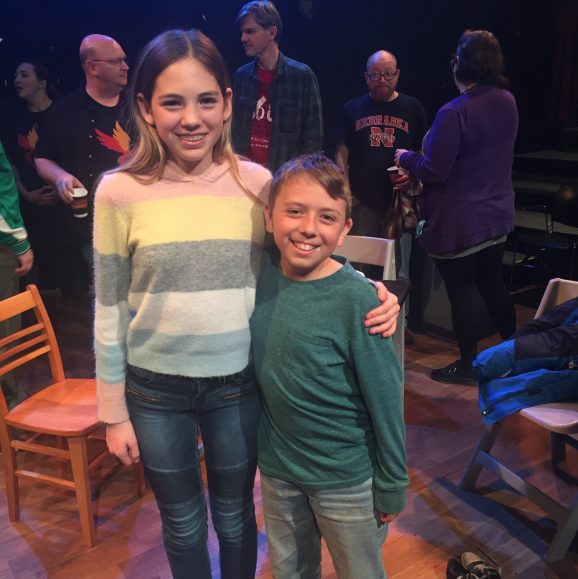
In the most hair-raising scene, Abby Grattan as Malibu is forced to strangle the young boy (played by Nate Dimpel Alvarez) brought in in chains, whose parent took money to have him ‘disappear.’
‘The Sound of Waves Crashing on an Island of Broken Glass,” an original play by Shawn Overton, directed by Rob Hypes and produced by the Phoenix Creative Collective, a Merced-based performing arts organization, was performed at the Black Box Theater in the Merced Multicultural Arts Center between March 14 and 17.
The play is the dramatic life and death story of a teenager (played by Abby Grattan) who has been raised by toxic parents (played by Noelle DW Chandler and Andrew Burkum) in an isolated area, and it focuses on her agonizing journey of self-discovery ending with a plan conceived out of desperation which is her only healthy option — to cut ties to save herself.
The heroine in Overton’s play is a girl who does not know her own birth name and has always been called Malibu by her parents, which is the name of a town, which makes no sense.
She lives in a remote area in Idaho — a deliberate attempt on the part of her parents to hide their deranged lifestyle from the FBI and from her grandfather, who is searching for her in order to rescue her.
Her last memory of the outside world before her life was uprooted by the move was being immersed in ballet class at the age of 5, where her teacher (played by Jessica Dimpel) carefully guided and directed the students to develop as dancers by focusing the energy and power inside themselves to attain perfect control and precision.
During the play, in Malibu’s mind, she visualizes her dance teacher instructing the pupils along these lines — only the pupils are those murdered by her parents!
When she tried to run away from home once, her mother took away her shoes and commanded her father to break bottles and place cut glass around the house.
When her grandfather (played by David Hambley) appears in chains in the morning, Malibu, who is making pancakes for breakfast, asks him, “Are you a problem?”
Mal carefully weighs the reality her grandfather imparts — that her parents are not good people, and that he has been searching for her almost as long as she has been alive and has spent every penny doing so; that although he only saw her from a distance when she was 5, he loves her because she is his granddaughter.
However, she is not quite ready to leave home.
When he tells her to take her mother’s truck and get away, she says resolutely, “I’m not going. My parents love me.”
He warns her that she will find out that they don’t care about her.
Later, the audience discovers that Grandfather was in fact a “problem” and that problems are her parents’ term for anything that has to be solved, which could include people, and to her mother’s way of thinking, solving the problem could mean options such as “relocation, renegotiation, compensation or when there are no other options, we have to euthanize them”.
In the next scene, Grandfather is being taught first through fifth position by Mal’s dance teacher somewhere in Mal’s mind and heart, and Mal’s parents are at home with her.
What will happen to the young girl, who has no protection other than her own ability to make sense of things by applying what she has read in books, and her own cleverness?
Overton’s play takes an in-depth look at people faced with whether to embrace a culture they cannot in all good conscience accept and making the decision to cut ties to save themselves.
The play deals with an extreme situation, but in daily life bonds are broken all the time. Friendships end and relationships dissolve. No one really pays much attention, as long as the evidence shows that the person in question started poisoning the other’s well-being and mental state.
There is still overwhelming guilt for some people breaking long-standing ties, especially familial ones.
At the conclusion, Mal reads a statement to her parents. She expresses her understanding of their motives but asks them to reconsider their decision as to her death. Her plea falls on deaf ears.
Will she survive?
The play asks the essential questions.
Did one make a good faith attempt to maintain order in the relationship?
Did one explore all options of mending the relationship?
Has the toxic person been given an opportunity to do the right thing?
The play seems to be saying that if so, and if all these steps taken were taken to no avail, then making the exhausting and painstakingly difficult but necessary decision to cut ties from this person, even if a blood relative, is perceived as a healthy choice and it could be the only choice that allows for survival in the hopes of building a healthy future.
After the show, Overton was asked what drives the darkness conveyed in his play?
He answered, “For me, I just find that’s where the drama is, that’s where the emotion is. It’s an interesting space to explore, what is hidden, where our fears lie. Any darkness that is there is a well of interest. Tapping into that provides a great place for stories to captivate people and draw them in.”